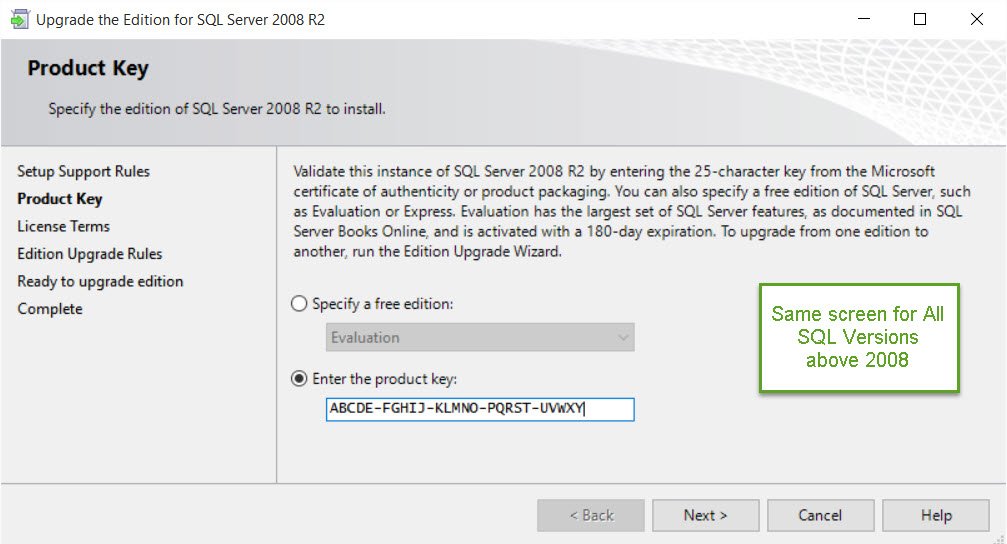
- Could any one provide me the working of product key for SQL server 2008 enterprise version. I was tried for above provided keys.But nothing is working for me. Pls share if any one have the license key for Enterprise edition SQL server 2008.
- The Microsoft JDBC Driver for SQL Server supports the optional JDBC 3.0 APIs to retrieve automatically generated row identifiers. The main value of this feature is to provide a way to make IDENTITY values available to an application that is updating a database table without a requiring a query and a second round-trip.
- Sequences are new in SQL Server 2012 and not available in earlier versions. Use CREATE TABLE YourTable (ID INT IDENTITY) - the mechanism in SQL Server 2008 is IDENTITY.Read about IDENTITY on MSDN SQL Server Books Online – marcs Mar 23 '13 at 10:02.
- Sql Server 2008 R2 Key Crack
- Sql Server 2008 R2 Key Generator Manual
- Sql Server 2008 R2 Product Key Crack
- Sql Server 2008 R2 Enterprise
Windows Server 2008 R2 Standard - YC6KT-GKW9T-YTKYR-T4X34-R7VHC Windows Web Server 2008 R2 - 6TPJF-RBVHG-WBW2R-86QPH-6RTM4 This will give them a 30 or 60 day grace period (provided you rearm the machine during sysprep) before forcing them to enter their own key (unless they run their own KMS server, in which case, it will just activate for them). In SQL Server Management Studio I am able to generate a create script which creates the database but it doesn’t contain any test data. Ideally when the script is run it should DROP the existing database (assuming it already exists) and then recreating it using this new script containing schema changes and test data from my development machine.
I'm trying to generate a CSR for an SSL certificate to encrypt connections to my SqlServer 2008 instance located on a Windows Server 2008 server. Most of the documentation I've read mentions using the CSR wizard in IIS. This is a dedicated db server which does not have IIS installed. May 22, 2017 List of the bugs that are fixed in SQL Server 2008 R2 Service Pack 1 Content provided by Microsoft Applies to: SQL Server 2008 R2 Standard SQL Server 2008 R2 Standard Edition for Small Business SQL Server 2008 R2 Enterprise SQL Server 2008 R2 Express SQL Server 2008 R2 Express with Advanced Services SQL Server 2008 R2 Datacenter SQL Server 2008.
Creates a database master key in the master database.
Sql Server 2008 R2 Key Crack
Syntax
Arguments
PASSWORD ='password'Is the password that is used to encrypt the master key in the database. password must meet the Windows password policy requirements of the computer that is running the instance of SQL Server. password is optional in SQL Database and SQL Data Warehouse.
Remarks
The database master key is a symmetric key used to protect the private keys of certificates and asymmetric keys that are present in the database. When it is created, the master key is encrypted by using the AES_256 algorithm and a user-supplied password. In SQL Server 2008 and SQL Server 2008 R2, the Triple DES algorithm is used. To enable the automatic decryption of the master key, a copy of the key is encrypted by using the service master key and stored in both the database and in master. Typically, the copy stored in master is silently updated whenever the master key is changed. This default can be changed by using the DROP ENCRYPTION BY SERVICE MASTER KEY option of ALTER MASTER KEY. A master key that is not encrypted by the service master key must be opened by using the OPEN MASTER KEY statement and a password.
The is_master_key_encrypted_by_server column of the sys.databases catalog view in master indicates whether the database master key is encrypted by the service master key.
Information about the database master key is visible in the sys.symmetric_keys catalog view.
For SQL Server and Parallel Data Warehouse, the master key is typically protected by the service master key and at least one password. In case of the database being physically moved to a different server (log shipping, restoring backup, etc.), the database will contain a copy of the master key encrypted by the original server service master key (unless this encryption was explicitly removed using ALTER MASTER KEY DDL), and a copy of it encrypted by each password specified during either CREATE MASTER KEY or subsequent ALTER MASTER KEY DDL operations. In order to recover the master key, and all the data encrypted using the master key as the root in the key hierarchy after the database has been moved, the user will have either use OPEN MASTER KEY statement using one of the passwords used to protect the master key, restore a backup of the master key, or restore a backup of the original service master key on the new server.
For SQL Database and SQL Data Warehouse, the password protection is not considered to be a safety mechanism to prevent a data loss scenario in situations where the database may be moved from one server to another, as the Service Master Key protection on the Master Key is managed by Microsoft Azure platform. Therefore, the Master Key password is optional in SQL Database and SQL Data Warehouse.
Important
You should back up the master key by using BACKUP MASTER KEY and store the backup in a secure, off-site location.
The service master key and database master keys are protected by using the AES-256 algorithm.
Permissions
Requires CONTROL permission on the database.
Examples
Use the following example to create a database master key in the masterdatabase. The key is encrypted using the password 23987hxJ#KL95234nl0zBe.
See Also
-->Returns the MD2, MD4, MD5, SHA, SHA1, or SHA2 hash of its input in SQL Server.
Syntax
Arguments
<algorithm>
Identifies the hashing algorithm to be used to hash the input. This is a required argument with no default. The single quotation marks are required. Beginning with SQL Server 2016 (13.x), all algorithms other than SHA2_256, and SHA2_512 are deprecated.
@input
Specifies a variable containing the data to be hashed. @input is varchar, nvarchar, or varbinary.
'input'
Specifies an expression that evaluates to a character or binary string to be hashed.
The output conforms to the algorithm standard: 128 bits (16 bytes) for MD2, MD4, and MD5; 160 bits (20 bytes) for SHA and SHA1; 256 bits (32 bytes) for SHA2_256, and 512 bits (64 bytes) for SHA2_512.
Applies to: SQL Server 2012 (11.x) and later
For SQL Server 2014 (12.x) and earlier, allowed input values are limited to 8000 bytes.
Return Value
varbinary (maximum 8000 bytes)
Remarks
Consider using CHECKSUM or BINARY_CHECKSUM as alternatives to compute a hash value.
The MD2, MD4, MD5, SHA, and SHA1 algorithms are deprecated starting with SQL Server 2016 (13.x). Use SHA2_256 or SHA2_512 instead. Older algorithms will continue working, but they will raise a deprecation event.

Sql Server 2008 R2 Key Generator Manual
Examples
Return the hash of a variable
The following example returns the SHA2_256 hash of the nvarchar data stored in variable @HashThis.
Return the hash of a table column
The following example returns the SHA2_256 hash of the values in column c1 in the table Test1.
Sql Server 2008 R2 Product Key Crack
Here is the result set.
Sql Server 2008 R2 Enterprise
See Also
Most Viewed News
- ✔ Office Professional Plus Key Generator
- ✔ Norton Security Product Key Generator
- ✔ Call Of Duty Modern Warfare 3 Steam Cd-key Generator.rar
- ✔ Ssh-3-keypair Attempt To Generate Server Keys Failed
- ✔ Microsoft Office 2010 Key Generator Kickass
- ✔ Random Wpa-psk Key Generator
- ✔ Photoshop Cc License Key Generator
- ✔ The Division Cd Key Generator
- ✔ Fifa 17 Cd Key Generator Password.txt
- ✔ Fallout New Vegas Cd Key Generator Free Download