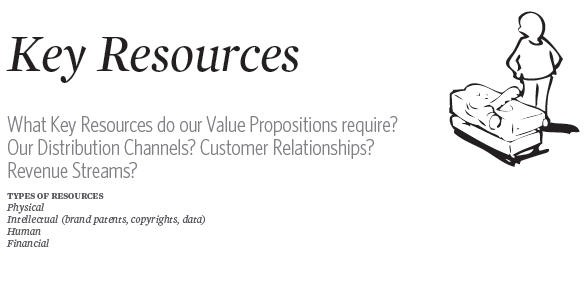
Business Model Generation is a handbook for visionaries, game changers, and challengers striving to defy outmoded business models and design tomorrow's enterprises. If your organization needs to adapt to harsh new realities, but you don't yet have a strategy that will get you out in front of your competitors, you need Business Model Generation. May 05, 2011 Business Model Generation Key Resources.mp4. May 05, 2011 Business Model Generation Key Resources.mp4. Fitness for Success Business Model Canvas. Key Partners Who are your key partners? They depend on each other to help drive more business. Current Members. Leverage current members connections to drive business. Work together with members to constantly make the gym a better place. What are your key resources? Cardio Equipment.
Eric Denna, CIO for the University of Utah and the Utah System of Higher Education, is the 2014 Viewpoints department editor for EDUCAUSE Review.
According to a recent search for the term 'changing business model' on The Chronicle of Higher Education website, the term was used more than 2,000 times during the past three years. A quick reading of even just a few of the references reveals that the term is used rather loosely—which seems ironic for a community that prides itself on precision in language. This lack of precision suggests that although there is significant interest in the term, there is little agreement on what it means.
Furthermore, the lack of precision in the use of the term 'business model' is resulting in gross generalizations, sloppy thinking, and unrealistic expectations about the nature and future of the business model of higher education. This allows others—others outside of higher education—to drive the conversation, with little rigor and even less familiarity with the history and nature of higher education, let alone its future. The collective lack of understanding about the nature of a business model in higher education results in academics being excluded from critical policy discussions at the institution, local, state, and federal levels—where many are equally unclear about the nature of business models in general and within higher education specifically.
Business Model Generation Key Resources Examples
To make matters worse, reactions to the term 'business model' within higher education range from 'higher education is not a ^#%[email protected]* business' to 'what in the world is a business model?' As a result, those of us in higher education come off as naïve at best and as head-in-the-sand intransigents at worst. To many, we seem to be saying: 'Let the rest of the sectors of the economy—whether medicine, construction, manufacturing, publishing, governments (all levels), governmental agencies, professional services, entertainment, libraries, whatever—enjoy being disrupted. Higher education is different.'
Why is all of this important to CIOs and other IT leaders? As Clayton Christensen explains, disruption of business models involves technology (and not just what IT leaders would typically call information technology). Since we IT leaders have primary responsibility to plan, build/install, and run information technology on campus, we are naturally poised to participate in the discussion about the future business model of higher education. Not participating marginalizes us in the strategic conversations of the academy. We become technologists instead of active members of the CxO crowd.
So, what exactly is a business model? With my background as a business school professor, an entrepreneur, and a senior executive or board member in many for-profit and not-for-profit organizations, business models have always been part of my world. However, about three years ago the concept of a business model became much easier for me to talk about when I was introduced to the book Business Model Generation, written by Alex Osterwalder and Yves Pigneur. The book grew out of their work at HEC Lausanne in Switzerland. Osterwalder and Pigneur provide a framework for a business model in the form of a template or canvas, which they call the Business Model Canvas, consisting of nine components:
- Customer Segments
- Value Propositions
- Customer Channels
- Customer Relationships
- Revenue Streams
- Key Activities
- Key Resources
- Key Partners
- Cost Structure1
Many academics seem to struggle with the notion of a higher education business model because they can't get past the language barrier. In response, I have translated the nine components of the Business Model Canvas into a series of nine questions that I hope are more useful for higher education (those of you who read my January/February 2014 Viewpoints column in EDUCAUSE Review will recognize some of the questions):
- Who do we serve, and what are they trying to do?
- How do we help those we intend to serve do what they are trying to do?
- How do we deliver our services to those we are trying to serve?
- What is the nature of the relationship we have with those we serve?
- How do these prior components translate into revenue for our institution?
- What are the key activities that create the services we provide?
- What are the key resources we need to create the services we provide?
- Who are the key partners that help us create the services we provide to those we serve?
- How do the key partners, resources, and activities translate into our institution's cost model?
Answering these questions puts the IT leader squarely in a business model discussion without ever having to use the cursed 'BM' word. More important, these questions and the underlying model can provide insights into just how higher education is being disrupted. Applying a framework like the Business Model Canvas to each of the oft-sited disruptors of higher education will begin to reveal some general trends. A recent and rather concise description of these disruptive trends in higher education was offered by MIT in Institute-wide Task Force on the Future of MIT Education: Preliminary Report:
The digital revolution can be felt across a number of industries, from publishing to media to retail, with the following trends surfacing across the spectrum:
- Massive scale of adoption: YouTube, for example, claims a viewership of over one billion unique viewers and over six billion hours of video watched every month.
- Increased potential and demand for disaggregating or unbundling products: Newspapers have become disaggregated into individual articles available piecemeal online. These are often curated and aggregated by other online sites such as The Huffington Post or Drudge Report. Apple unbundled albums into 99-cent songs, and users re-aggregate individual songs into their own playlists.
- Blurring of boundaries: Traditional boundaries in various media and platforms are becoming less distinct, creating new opportunities and greater potential for collaboration. The availability of online video through YouTube, iTunes, Hulu, and other sources, for example, has blurred the boundaries between traditional television programming, cable, computers, and mobile phones. Telecommuting has the same effect on the division between offices and homes. Online retail has blurred the boundaries between brick-and-mortar stores such as Walmart, electronic commerce sites such as Amazon, and auction sites such as eBay.
- Affordability and access: The public conversation about the affordability of higher education and the impact of cost on access for all of those desiring to go to college is growing. There is also a growing conversation about the value of education that does not immediately result in jobs.2
What does all this have to do with the business model of higher education? The key lies in how these four trends change the answers to the nine questions I listed earlier. In fact, what might be more important is how these trends change the answers to the nine questions when they are rephrased to look to the future:
- Who should we serve, and what are they trying to do?
- How should we help those we intend to serve do what they are trying to do?
- How should we deliver our services to those we are trying to serve?
- What should be the nature of the relationship we have with those we serve?
- How should these prior components translate into revenue for our institution?
- What should be the key activities that create the services we provide?
- What should be the key resources we need to create the services we provide?
- Who should be the key partners that help us create the services we provide to those we serve?
- How should the key partners, resources, and activities translate into our institution's cost model?
Although I am tempted to offer my own answers to these questions (both the 'do' and the 'should' forms), my professor side suggests that this is a good homework assignment. In fact, answering these questions is a great group exercise. In my experience, the process of answering the questions, and reconciling the answers across the campus community (in part and as a whole), is at least as important as, if not more important than, the answers themselves. Why? Because the answers will likely change a great deal during the coming years. Therefore, a key activity for keeping the business model of higher education viable will be the community's ability to engage in asking and answering these questions and then implementing the answers.
Only one thing seems certain: the last ten years are not a good predictor of the next ten. Some in higher education (e.g., senior administrators, members of the faculty senate, deans, or department chairs) may be tempted to think that they can manage, or even minimize, the disruption that is under way. And some self-avowed 'elite' schools may think that the disruption does not even apply to them. But those who feel they are immune from business model disruption are the ones who should be the most worried.
In conclusion, let me be clear: much of the disruption of the higher education business model is the result of leveraging technology. Therefore, IT leaders have a natural and important role to play in the conversation about the business model of higher education. Using a tool like the Business Model Canvas, or answering the questions listed above, should provide the framework for any IT leader not only to participate but to be a key player in the future of higher education.
Key Resources Business Examples
- Alexander Osterwalder and Yves Pigneur, Business Model Generation: A Handbook for Visionaries, Game Changers, and Challengers (Hoboken, N.J.: Wiley, 2010). A video introduction to the Business Model Canvas is available here. Osterwalder’s blog, Business Model Alchemist, offers a wonderful account of the development of the Business Model Canvas.
- Institute-wide Task Force on the Future of MIT Education: Preliminary Report, November 21, 2013, pp. 8–9.
© 2014 Eric Denna. The text of this article is licensed under the Creative Commons Attribution-NonCommercial 4.0 International License.
Business Model Generation Handbook
EDUCAUSE Review, vol. 49, no. 2 (March/April 2014)
Please enable JavaScript to view the comments powered by Disqus.Advertisement
Advertisement
Advertisement
Most Viewed News
- ✔ Steam Key Generator No Survey 2014
- ✔ The Sims 4 Serial Key Generator Password Txt
- ✔ Fifa 17 Cd Key Generator Password.txt
- ✔ Generate Pre-shared Key Openvpn
- ✔ Batman Arkham Asylum Mac Product Key Generator
- ✔ Microsoft Office Key Generator 2015
- ✔ Master Key Code Generator Nintendo 3ds
- ✔ Rsa Public Private Key Pair Generator